
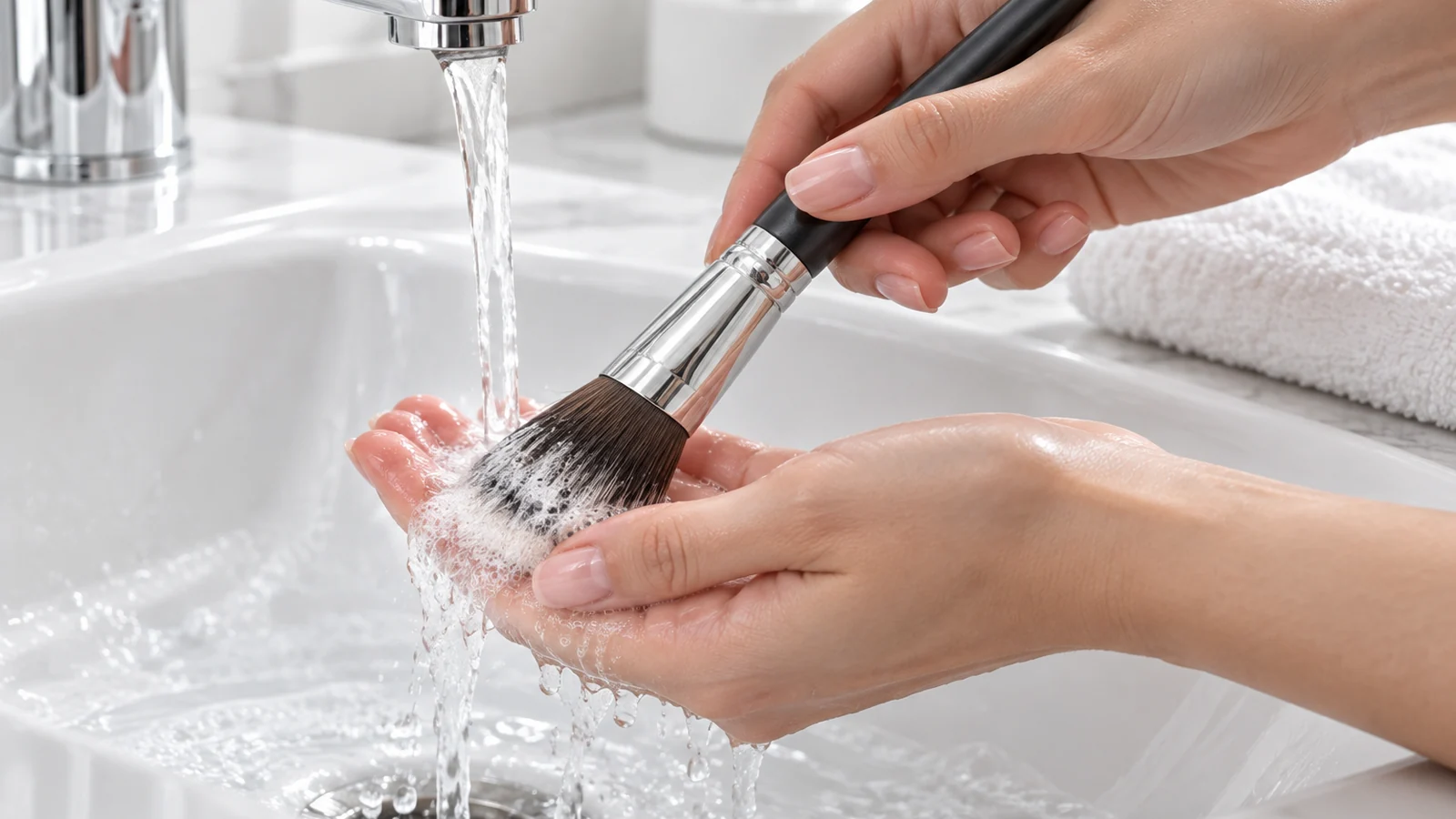
AAD recommends washing personal brushes every seven to ten days. This schedule does not replace between-client hygiene in professional work. Follow the tool manufacturer’s guidance too. The following sections explore decisions, application and common pitfalls step by step.
Personal brushes
AAD recommends washing personal brushes every seven to ten days. This schedule does not replace between-client hygiene in professional work. Follow the tool manufacturer’s guidance too.
Maintain personal brushes on a regular schedule appropriate to their use and manufacturer instructions. Shared tools, pads and sponges have different requirements. A home brush-cleaning schedule is not a sufficient professional protocol for different clients.
Clean the tips
Remove residue from the tips using lukewarm water and a suitable cleanser. Avoid soaking the head-to-handle connection, which can weaken its adhesive.
Use gentle movements to release pigment; pulling hard on the bristles can distort their shape. Keep the head pointing downward and wet only the area needed. Rinse thoroughly to remove cleanser residue.
Rinse and dry
Rinse until the water runs clear. Gently remove excess water and dry flat with tips beyond the surface edge. Do not stand wet brushes upright in a cup.
Use a clean towel to remove excess water without aggressively twisting the bristles, then restore their shape. Drying time varies with size and density. Check that the brush is fully dry before putting it into a closed container.
Prepare before application
Keep clean dry tools separate from used ones. Tool hygiene is part of the technique and should be checked before starting.
Separate clean and used tools on the workstation. Inspect bristle shape and the ferrule connection before starting. Do not keep using a damaged or unsuitable tool simply because it is familiar; control also depends on tool condition.
Separate clean and used tools
Keep a defined clean-tool area and a separate container for used tools. Do not return a brush to the clean area after skin contact. Dispense product onto a separate palette with a clean tool and avoid returning a used applicator to a shared container.
Drying and quality checks
Follow the brush maker’s washing and care guidance. Ensure tools are dry and free of visible residue before use. Visible cleaning is not the same as sterilisation; retire damaged or unsuitable tools.
Frequently asked questions
Should wet brushes stand upright?
Dry them flat with the tips clear of the surface edge, following manufacturer instructions.
Is washing the same as disinfection?
No. The necessary procedure depends on tool use and hygiene-product instructions.
Do all brushes dry in the same time?
No. Size and density vary. Check they are fully dry before use or closed storage.


